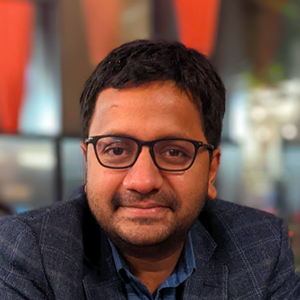
Karthik Shekhar is John F. Heil Jr. Professor in the chemical and biomolecular engineering department at the University of California, Berkeley. His laboratory is cross-affiliated with neuroscience, vision science and the Lawrence Berkeley Laboratory. His interests are at the interface of neuroscience, genomics and applied mathematics, and his group uses both experimental and computational approaches to understand how diverse types of neurons in the brain develop and evolve, and how they become selectively vulnerable during diseases. He has received the NIH Pathway to Independence Award, the Hellman Fellowship and the McKnight Fellowship in Neuroscience. He also recently received the Donald E. Noyce Prize for Excellence in Undergraduate Teaching.
Karthik Shekhar
Assistant professor of chemical and biomolecular engineering
University of California, Berkeley
From this contributor
Building a brain: How does it generate its exquisite diversity of cells?
High-throughput technologies have revealed new insights into how the brain develops. But a truly comprehensive map of neurodevelopment requires further advances.
Building a brain: How does it generate its exquisite diversity of cells?
Explore more from The Transmitter
Are Brains and AI Converging?—an excerpt from ‘ChatGPT and the Future of AI: The Deep Language Revolution’
In his new book, to be published next week, computational neuroscience pioneer Sejnowski tackles debates about AI’s capacity to mirror cognitive processes.
Are Brains and AI Converging?—an excerpt from ‘ChatGPT and the Future of AI: The Deep Language Revolution’
In his new book, to be published next week, computational neuroscience pioneer Sejnowski tackles debates about AI’s capacity to mirror cognitive processes.
New tissue-clearing techniques let microscopes peer deeper into living brains
Washing mouse brain tissue with a blood protein or complex sugar can illuminate cells 550 micrometers into the cortex without compromising its normal physiology.
New tissue-clearing techniques let microscopes peer deeper into living brains
Washing mouse brain tissue with a blood protein or complex sugar can illuminate cells 550 micrometers into the cortex without compromising its normal physiology.
New catalog charts familial ties from autism to 90 other conditions
The research tool reveals associations stretching across three generations.
New catalog charts familial ties from autism to 90 other conditions
The research tool reveals associations stretching across three generations.