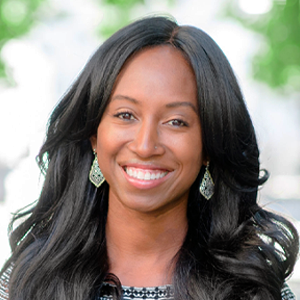
Headshot of Letisha R. Wyatt.

Letisha R. Wyatt

Associate professor of neurology
Oregon Health and Science University

Letisha R. Wyatt, is associate professor of neurology at Oregon Health and Science University. She earned her Ph.D. in molecular pharmacology and toxicology from the University of Southern California in 2013. Her graduate and postdoctoral research focused on purinergic signaling in the central nervous system as a molecular target for new treatments for alcoholism and stroke.

Wyatt is a former National Institutes of Health predoctoral fellow and has a strong record of mentorship in the laboratory and classroom. She has held prior faculty appointments in the OHSU Library and the Cancer Early Detection Advanced Research Center (CEDAR), working together with researchers to support open-science practices and data stewardship needs. Wyatt also oversees the development and implementation of training programs for scientists from historically minoritized groups and serves as director of innovative policy at the Racial Equity and Inclusion Center. Read more about Wyatt on her personal website, and view her work on ORCID.
Explore more from The Transmitter

Illustration of two neon-toned sets of concentric circles overlapping, with bright spots where they intersect.

Are Brains and AI Converging?—an excerpt from ‘ChatGPT and the Future of AI: The Deep Language Revolution’

In his new book, to be published next week, computational neuroscience pioneer Sejnowski tackles debates about AI’s capacity to mirror cognitive processes.

By Terrence Sejnowski
21 October 2024 | 12 min read

New tissue-clearing techniques let microscopes peer deeper into living brains

Washing mouse brain tissue with a blood protein or complex sugar can illuminate cells 550 micrometers into the cortex without compromising its normal physiology.

By Calli McMurray
18 October 2024 | 0 min watch
A younger looking set of hands holds an older looking set of hands.

New catalog charts familial ties from autism to 90 other conditions

The research tool reveals associations stretching across three generations.

By Charles Q. Choi
17 October 2024 | 4 min read