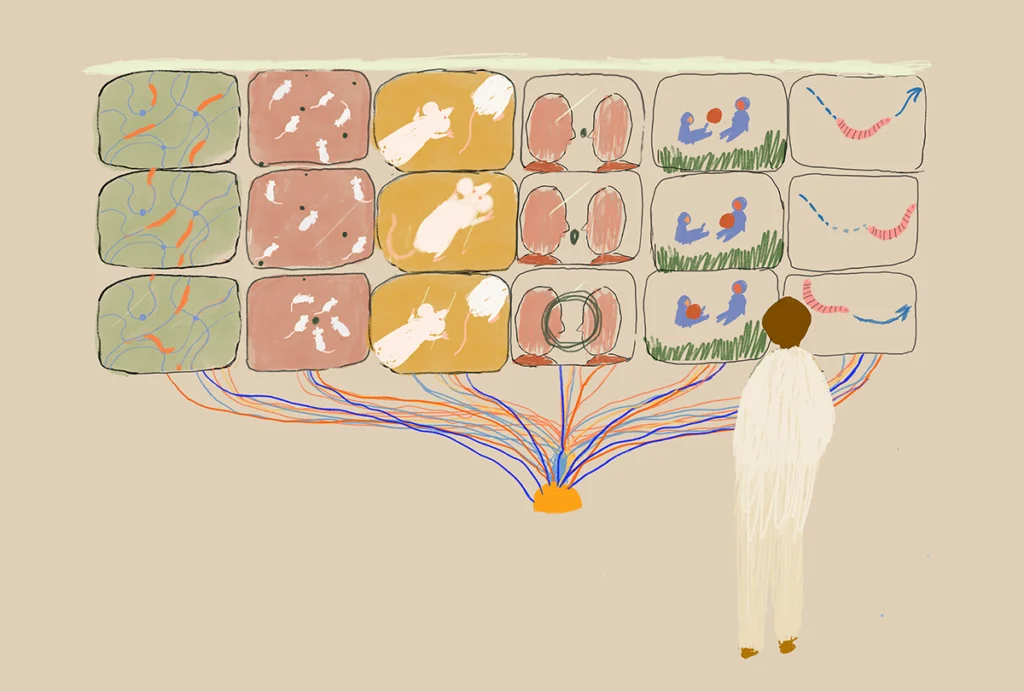
Robert Froemke is Skirball Foundation Professor of Genetics in the Neuroscience Institute and the otolaryngology and neuroscience departments at NYU Grossman School of Medicine. His lab studies neuromodulation, plasticity and behavior in rodents and humans. Froemke has a background in systems neuroscience, having performed Ph.D. work with Yang Dan at the University of California, Berkeley on spike-timing-dependent plasticity induced by natural spike trains in cortical networks. His postdoctoral research with Christoph Schreiner at the University of California, San Francisco focused on synaptic plasticity in vivo as related to auditory perception and behavior.
Froemke started his faculty position at NYU Grossman School of Medicine in 2010. He studies the synaptic mechanisms by which sounds acquire meaning, with a focus on oxytocin, maternal behavior and the use of neuroprosthetic devices, such as cochlear implants. For this work, he was awarded Sloan and Klingenstein Fellowships, and Pew and McKnight Scholarships. In 2021, Froemke was honored to receive a Landis Award for Outstanding Mentorship from the National Institute of Neurological Disorders and Stroke.